Click to earn websites...


uTorrent 3.0 Build 26473


µTorrent is an efficient and feature rich BitTorrent client for Windows sporting a very small footprint. It was designed to use as little CPU, memory and space as possible while offering all the functionality expected from advanced clients.
Micro-Sized Yet Feature Filled

Most of the features present in other BitTorrent clients are present in µTorrent, including bandwidth prioritization, scheduling, RSS auto-downloading and Mainline DHT (compatible with BitComet). Additionally, µTorrent supports the Protocol Encryption joint specification (compatible with Azureus 2.4.0.0 and above, BitComet 0.63 and above) and peer exchange.

Resource-Friendly
µTorrent was written with efficiency in mind. Unlike many torrent clients, it does not hog valuable system resources - typically using less than 6MB of memory, allowing you to use the computer as if it weren't there at all. Additionally, the program itself is contained within a single executable less than 220 KB in size.

Skinnable and Localized
Various icon, toolbar graphic and status icon replacements are available, and creating your own is very simple. µTorrent also has support for localization, and with a language file present, will automatically switch to your system language. If your language isn't available, you can easily add your own, or edit other existing translations to improve them!

Actively Developed and Improved
The developer puts in a lot of time working on features and making things more user-friendly. Releases only come out when they're ready, with no schedule pressures, so the few bugs that appear are quickly addressed and fixed.
What's new in this release:
  • Fix: fixed incorrect teredo MTU assumption
  • Fix: fix bug where the rating was not bound-checked in the comments tab
Download: uTorrent 3.0 Build 26473 | 627 KB Freeware

VMware Player 4.0.1 Build 528992


VMware Player is the easiest way to run multiple operating systems at the same time on your computer. With its user-friendly interface, VMware Player makes it effortless for anyone to try out Windows 7, Chrome OS or the latest Linux releases, or to create virtual "sandboxes" to test pre-release software in. VMware Player can also be used to run a virtual copy of an old PC so that you can recycle the old machines you have under your desk or stored in the closet.
  • Run multiple operating systems simultaneously on a single computer
  • Experience the benefits of preconfigured products without any installation or configuration hassles
  • Share data between host computer and virtual machine
  • Run 32- and 64-bit virtual machines
  • Use 3rd-party pre-configured virtual machines and images
  • Share data between the host computer and virtual machine
  • Broad host and guest operating system support
  • Support for USB 2.0 devices
  • Gain easy access to virtual machines via an intuitive home page interface
Download: VMware Player 4.0.1 Build 528992 | 117 MB (Freeware, registration required)

Microsoft and Apple support censorship bill


Companies like Google, Mozilla and Facebook have been speaking out against the Stop Online Piracy Act (SOPA), but Apple and Microsoft have obliquely thrown their support behind the legislation. Microsoft, along with Apple, Adobe, and a host of other major companies are part of the Business Software Alliance which supports the bill, VentureBeat reports.

The Senate bill, the PROTECT IP Act ('Prevent Real Online Threats to Economic Creativity and Theft of Intellectual Property') was introduced back in May by Sen Patrick Leahy (D), but is currently on indefinite hold. SOPA was introduced to the House on Oct. 26. The bill would force American payment providers, like Visa or PayPal, to cut off transactions with infringing sites, even those that are located overseas.
The Business Software Alliance, made up of tech giants like Microsoft, Apple, Adobe and Dell, stated in a low key press release from back when SOPA was first introduced that they supported the bill. This explains Microsoft's silence on the bill, while other companies are rallying against it. Robert Holleyman, President and CEO of the BSA said that it was “...Important to strike the right balance between two sets of considerations – enabling effective action against online pirates, while ensuring the law does not impede technology innovation or the evolution of software and the internet...”

Due to the drastic changes it would cause in the way users access websites, some experts are afraid that it could do just that, according, ironically enough, to MSNBC. The bills also give federal courts the power to order ISPs, as well as search engines, to block websites that they feel infringe on intellectual property. This would require filtering DNS servers – the servers that match the address that you enter (neowin.net) to the IP (74.204.71.247). The filtered DNS wouldn't be able to connect the address that you enter with the IP you need to connect to the website.

Another problem is deciding what constitutes an infringing website. If every website hosting pirated content were to be blocked, virtually all user-created content portals, from YouTube to Windows Live Skydrive, would be taken down. Even though these sites have legitimate uses and are commercial products, the fact that some users upload pirated content would give the copyright owners justification to have them blocked, if SOPA passes.

It's sad to see Microsoft supporting a bill that is so dangerous to digital freedom, even if the support is coming from an organization that they are part of, rather than them independently. Luckily, even with some high profile support, SOPA has many high profile opponents, too, both in government and the technology industry. Right now, the chances of it becoming law are slim, but the scary truth is that another bill that's just as bad (or worse) will replace it before it's cleared the floor. As soon as one threat to internet freedom is defeated, another rises in its place. There's no time for complacency.
Head over to the Neowin Forums to join the discussion and share your thoughts on SOPA and internet freedom.

EMDB 1.36


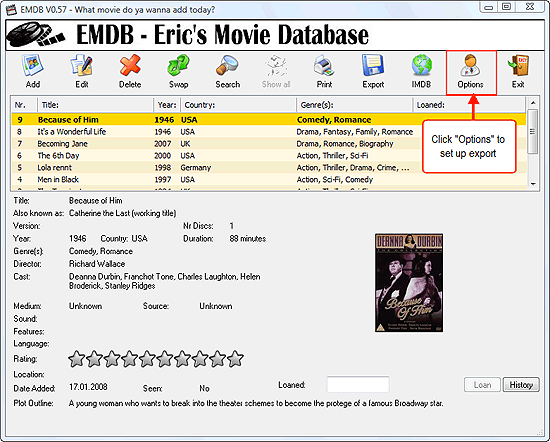
EMDB is a small utility to keep track of your DVD collection. With an automatic import from the database of IMDB, export to csv, text or complete website, thumbnail cover preview, a loan tracker, search function and multi-language user interface. EMDB is written in C++ using Microsoft Visual Studio 2005 and doesn't need a .NET framework or any other external libraries.


Changelog:
  • Import from HDD: New user interface with lots of options.
  • User Interface: Fixed sorting on numbers when more than 9999 movies in the database. Works fine now up to a million movies. That should be enough ;-)
  • Import from HDD: Fixed a crash when importing large number of movies in several sub folders.
  • Import from HDD: Movies with multiple results were you should select one from a list are queued until all automatic resolved movies are finished.
  • Import from HDD: Plot outline was not imported from Moviemeter.nl.
  • Import from HDD: Director was not imported if Director was already in the database.
  • Import from HDD: Better handle full DVD and Bluray file structures.
  • User Interface: Covers in movie details panel were sometimes cropped.
  • User Interface: Show TV Series cases option was not working.
  • User Interface: Fixed sorting on resolution.
  • Translations: Updated the Greek, Turkish and Swedish translations.
Download: EMDB 1.36 | 1.2 MB (Freeware)

ApexDC++ 1.5.1


ApexDC++ is free P2P software for community sharing using the DC++ protocol. It is Open Source software published under GPL-2 allowing anybody to contribute. It has numerous features such as intelligent chunk spreading (super seeding), customization, themes, and a brand new user friendly GUI.
ApexDC++ is, and always will be, free from all forms of malware. The project is managed and developed by veterans of the P2P world.
The Direct Connect network is a decentralized network, made up of individual servers (hubs) that users join to share files with other members on that hub. Each hub is individually run by a fellow user of the Direct Connect network, and may have certain themes to the content on the hub. Hub owners set up rules to regulate their hub as they see fit. Direct Connect allows you to share files over the Internet without restrictions or limits.
What's new in 1.5.1:
  • Fix: Possible fix for arranging toolbar for remote desktop users
  • Change: Files that no longer exist in downloads folder will be pruned from queue on startup
  • Change: Added encrypted ADC Fun hub to favourites (only if TGO hub is detected)
  • Change: Installer has option to launch ApexDC++ on startup
Download: ApexDC++ 1.5.1 | 12.1 MB (Open Source)

TeraCopy 2.27


TeraCopy is a compact program designed to copy and move files at the maximum possible speed, providing the user a lot of features:
  • Copy files faster. TeraCopy uses dynamically adjusted buffers to reduce seek times. Asynchronous copy speeds up file transfer between two physical hard drives.
  • Pause and resume file transfers. Pause copy process at any time to free up system resources and continue with a single click.
  • Error recovery. In case of copy error, TeraCopy will try several times and in the worse case just skips the file, not terminating the entire transfer.
  • Interactive file list. TeraCopy shows failed file transfers and lets you fix the problem and recopy only problem files.
  • Shell integration. TeraCopy can completely replace Explorer copy and move functions, allowing you work with files as usual.
  • Full Unicode support.
Changelog:
  • Added: ‘Remove other’ to remove non-selected files from the list [Pro].
  • Added: Better handling multiple copy processes.
  • Added: Multiple retries to delete source files and folders after moving.
  • Added: Tray notification when adding files to the existing process.
  • Fixed: Problem with some non-Latin filenames.
  • Fixed: Copied files now have a correct creation time.
  • Added: WaitBeforeMinimize option to ini file.
Download: TeraCopy 2.27 | 2.8 MB (Freeware)

Inside Microsoft's secret "Socl" network

You may remember the rumors that were going around earlier this year about Microsoft's upcoming social network, which was going by Tulalip at the time. It turns out that Microsoft has been testing the service with select users since then, and The Verge's Thomas Houston got a sneak peak at the service, which they're now calling Socl.


The site features a sparse Metro design with bare bones navigation controls, and a heavy emphasis on search. You'll find a prominent search bar at the top of the page, which works kind of like a status update. The search bar lets you share what you're searching for, like 'live Dylan covers,' or what you're doing, such as saying you're 'at a live Dylan concert.' This will drop the appropriate Bing results into your feed, so your friends can see, share and comment on it. The items can be tagged by type, and it's a completely voluntary process, so you only share what you want (rest easy, you don't have to share your, ah, 'private' searches).
It's been reported that the tagging system is a bit too specific, since most people aren't going to be searching for generic terms like 'film' or 'technology,' but considering that its in such an early stage of development, it's a problem that will hopefully disappear.

One really novel feature that Socl brings to the table is video party, which lets you chat live with your friends via webcam and watch YouTube clips together. Like the rest of the site, it's built completely out of HTML5, so it's fast and easy to use. It's possible that this could be built using the Skype infrastructure that Microsoft recently acquired, but since the whole project has been fairly quiet, there's no word on that.


Socl is coming out of Microsoft's FUSE research group, so it may or may not actually end up getting a public release. The Verge says that Microsoft is planning on rolling out a larger public test via an invite system in the near future.

Ultimately, Socl looks like another part of Microsoft's campaign to make search 'less lonely,' as they put it in a recent press release. The business plan is all about driving more traffic to Bing, and it's easy to imagine Socl functioning not only as a stand alone product, but as a way for you to share your search results through other services, like Facebook and Twitter.

Images courtesy of The Verge